• The tensions between Iran, Israel, and the United States have once again brought the world’s attention to the fragile balance of power in the Middle East. What appears on the surface as a sudden military confrontation is, in reality, the result of decades of mistrust, political rivalry, and competing visions for regional dominance.
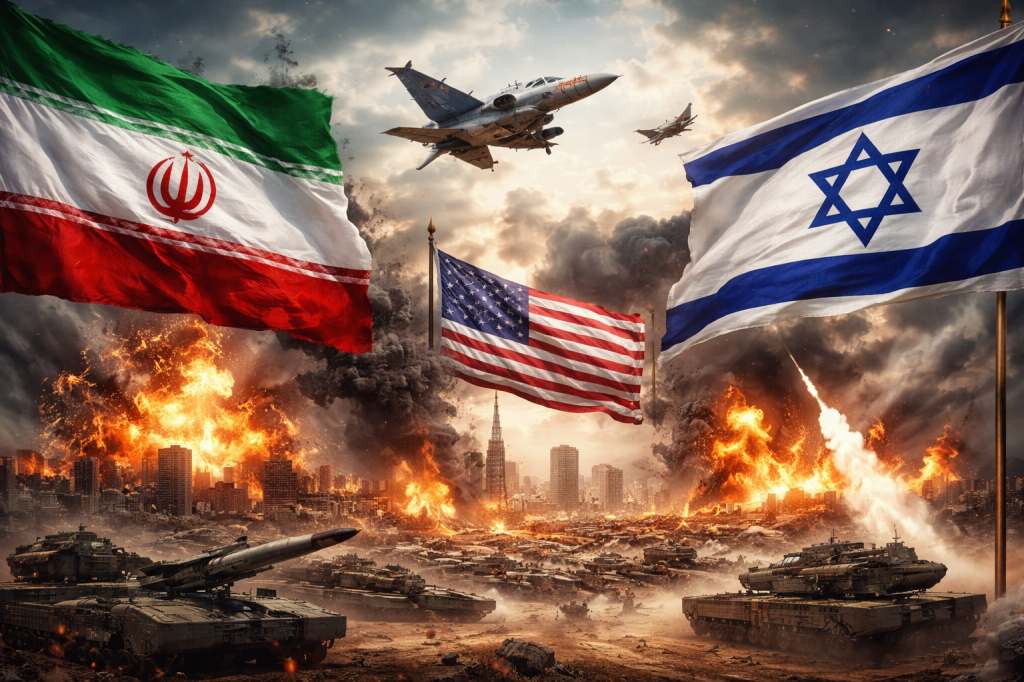
    The relationship between Iran and Israel has been deeply hostile since the 1979 Iranian Revolution, when Iran’s new leadership openly opposed Israel and its Western allies. Over time, this hostility expanded into a complex geopolitical struggle. Israel has consistently viewed Iran’s nuclear ambitions and missile programs as an existential threat, while Iran has framed Israel as a symbol of Western influence in the region. The United States, a long-time ally of Israel, has often positioned itself at the center of this rivalry, imposing sanctions on Iran and supporting efforts to curb its military capabilities.

    Recent events have intensified this long-standing conflict. In early 2026, coordinated military strikes by Israel and the United States targeted Iranian military infrastructure and nuclear facilities across several cities. These operations aimed to weaken Iran’s military strength and halt its nuclear development program. The strikes also eliminated several senior Iranian officials and military commanders, dramatically escalating tensions.

    Iran responded with missile and drone attacks directed at Israeli territory and American military bases across the Gulf region. The conflict quickly expanded beyond national borders, with strikes and security alerts reported in several Middle Eastern countries. Strategic locations such as the Strait of Hormuz — one of the most important oil transit routes in the world — became flashpoints of geopolitical tension, raising fears about disruptions to global energy supplies.

    Beyond the battlefield, the consequences of the conflict ripple through the global economy and international diplomacy. Oil prices fluctuate as markets react to uncertainty in the Gulf. Airlines reroute flights as regional airspace becomes unsafe. Governments around the world call for restraint, fearing that a prolonged conflict could destabilize not only the Middle East but also the global economic system.

    Yet, beneath the military operations and political statements lies a deeper reality: this conflict is not only about territory or weapons. It is about influence, ideology, and the future balance of power in the region. For Iran, it represents resistance against Western dominance. For Israel, it is framed as a matter of survival and security. For the United States, it reflects strategic interests in maintaining stability and protecting allies.

    History shows that conflicts in the Middle East rarely remain isolated events. They tend to reshape alliances, redefine global strategies, and remind the world how interconnected geopolitics truly is. As the Iran–Israel–U.S. tensions continue to unfold, the world watches closely, hoping diplomacy will eventually replace missiles and that dialogue will succeed where confrontation has repeatedly failed.
  • When a nation decides to send its own people into space, it is not merely launching a mission — it is launching belief, confidence, and a new chapter of history. That is exactly what Indian Space Research Organisation is doing with Gaganyaan.

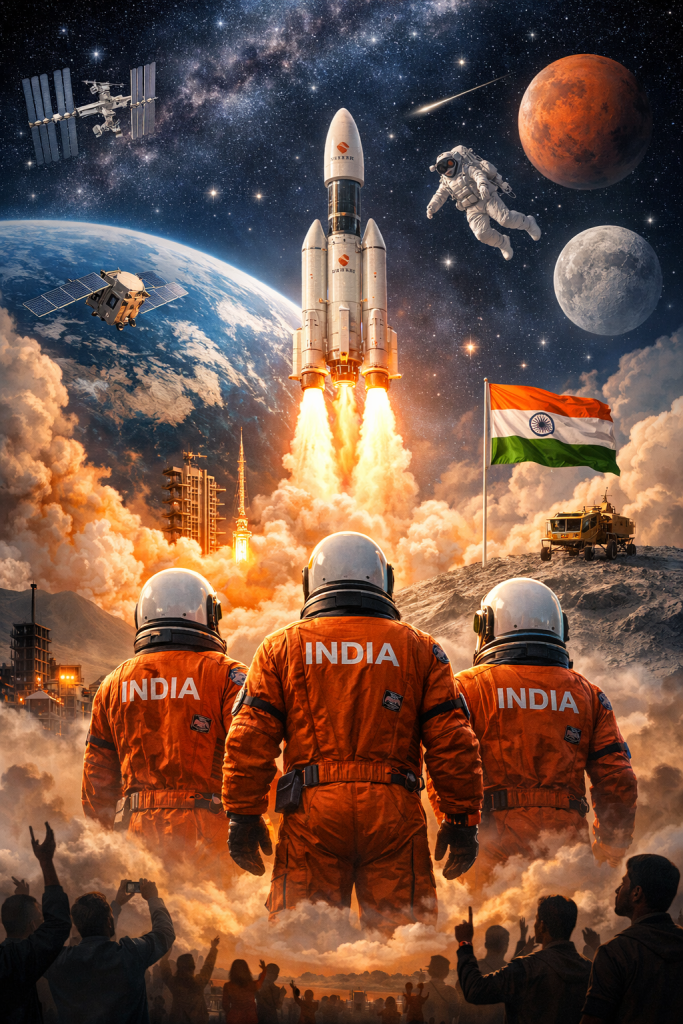
    Gaganyaan is India’s first human spaceflight mission — a bold step toward sending Indian astronauts into low Earth orbit aboard an indigenously developed spacecraft. For decades, India has demonstrated its space capabilities through satellite launches, lunar exploration, and interplanetary missions. From the success of Chandrayaan-3 to the precision of Mars Orbiter Mission, the world has watched India rise steadily in the space arena. But Gaganyaan represents something deeper. It represents trust in Indian engineering, Indian science, and Indian courage.

    This mission is designed to carry a crew of Indian astronauts into space for several days before bringing them safely back to Earth. The spacecraft, the launch vehicle, the life-support systems — everything is being developed with a singular purpose: to prove that India can independently execute human spaceflight missions. It is not just about reaching orbit; it is about mastering the complex science of sustaining life beyond Earth.

    Behind the scenes, years of preparation have unfolded quietly. Rigorous astronaut training, simulation tests, emergency recovery drills, and multiple uncrewed test flights are all part of this journey. Every bolt tightened, every line of code written, every system tested carries the weight of national aspiration. Human spaceflight demands near-perfection — and that pursuit of perfection is what defines Gaganyaan.

    More than a technological milestone, Gaganyaan is a psychological breakthrough. It signals to the youth of India that their dreams are valid, that science is powerful, and that ambition has no ceiling. When an Indian astronaut looks down at Earth from space, millions of young minds will look up with new confidence.

    The global space race is no longer about rivalry alone — it is about collaboration, innovation, and pushing humanity forward. With Gaganyaan, India steps into an elite group of nations capable of human spaceflight. It is a statement that India is not merely participating in the future — it is shaping it.

    History remembers the moments when nations choose courage over comfort. Gaganyaan is one of those moments. It is not just a mission. It is momentum.

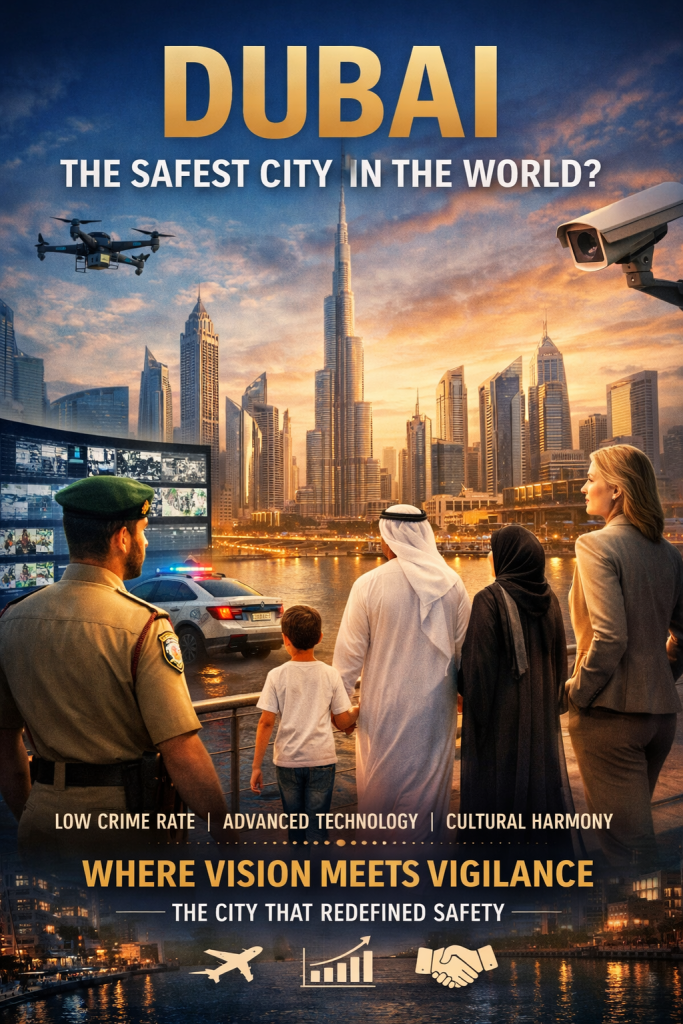
  • Is Dubai the safest city in the world? It’s a question often asked by travelers, entrepreneurs, investors, and dreamers alike. And the answer, more often than not, leans strongly toward yes.

    Dubai has built a global reputation not just for its iconic skyline and record-breaking architecture, but for something far more valuable — security and stability. In a world where uncertainty has become common, Dubai stands out as a city where safety is not accidental, but intentional.

    The foundation of this safety lies in strong governance and strict law enforcement under the leadership of the United Arab Emirates. Laws are clear, consequences are firm, and public order is maintained with consistency. Crime rates remain remarkably low compared to many global metropolitan cities. For residents, this means walking home at midnight without fear. For business owners, it means operating in an environment of trust.

    Technology also plays a major role. Advanced surveillance systems, smart policing, and AI-driven monitoring help authorities prevent crime rather than simply respond to it. Safety in Dubai is proactive. It’s engineered.

    Culturally, Dubai is home to over 200 nationalities living and working together. Despite its diversity, the city maintains social harmony. Respect for law and mutual coexistence are not just policies — they are social norms. This unique balance between multicultural freedom and disciplined order makes the city feel both global and secure.

    Economic stability further strengthens its safety. A thriving business ecosystem, tax-friendly policies, and a strong currency create an environment where opportunity reduces desperation. When systems function efficiently, crime struggles to find space.

    However, calling any city “the safest in the world” depends on metrics. Various global safety indexes frequently rank Dubai among the top cities worldwide for low crime rates and high public safety perception. While rankings may shift year to year, Dubai consistently remains in the top tier.

    Safety in Dubai is not just about low crime statistics. It is about confidence. Confidence for families. Confidence for investors. Confidence for solo travelers. It is the feeling of stepping into a city that values order as much as ambition.

    In a rapidly changing world, Dubai proves that growth and safety can coexist. That innovation does not require chaos. That global cities can still feel secure.

    So, is Dubai the safest city in the world? For many who live there, build there, and dream there — it certainly feels that way.

  • In every industry, there are salespeople. And then there are names that become standards. In the world of car sales, Joseph Jerad is not just a performer — he is a phenomenon.

    While others focus on numbers, Joseph focuses on people. While many chase targets, he builds relationships. And that subtle difference is what separates temporary success from lasting dominance.

    Car sales is not about metal, engines, or horsepower. It’s about emotion. A first car for a young entrepreneur. A family SUV for a growing household. A luxury upgrade after years of hard work. Joseph understands that every car is a milestone in someone’s life. He doesn’t sell vehicles — he delivers moments.

    What makes him stand at the top isn’t aggressive persuasion. It’s clarity. It’s listening. It’s knowing when to speak and when to let silence build trust. Customers don’t feel sold to; they feel understood. And in business, being understood is more powerful than being convinced.

    Top performers in sales often rely on tactics. Joseph relies on consistency. He shows up. He follows up. He keeps promises. In an industry where many overcommit and underdeliver, he has built his reputation on the opposite formula.

    The result? Referrals that compound. Repeat customers that return without hesitation. A personal brand that markets itself long before he makes a call.

    Success in car sales is often measured by monthly charts and annual awards. But true leadership is measured by the respect you earn in your market. Joseph Jerad’s real achievement is not just volume — it’s credibility.

    In a competitive landscape filled with noise, discounts, and flashy pitches, he chose a quieter strategy: integrity. And integrity scales.

    That’s why he isn’t just at the top of car sales charts. He’s at the top of minds when people decide who they trust with one of their biggest purchases.

    Not everyone sells cars.

    Some sell confidence.

    And those are the ones who stay on top.

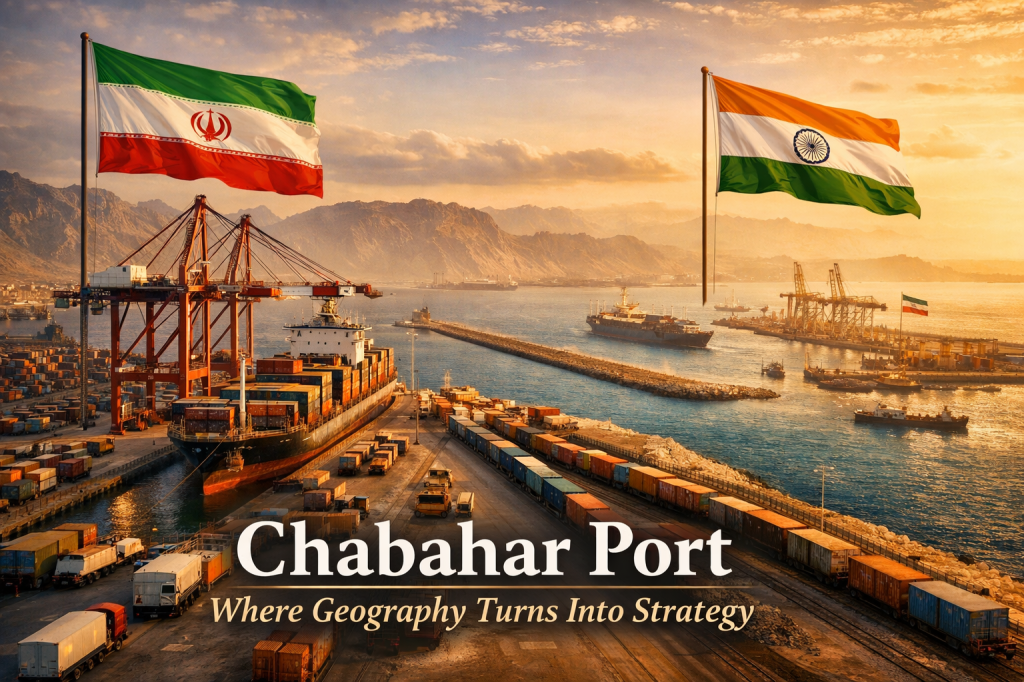
  • In a world where trade routes define power, influence, and opportunity, Chabahar Port stands as more than just a harbor on the southeastern coast of Iran. It is a statement. A corridor of ambition. A silent reshaping of regional economics.

    Positioned along the Gulf of Oman, Chabahar opens a direct maritime gateway that bypasses traditional chokepoints and political complexities. For decades, geography restricted access between South Asia, Central Asia, and beyond. Today, Chabahar rewrites that script. It connects India to Afghanistan and Central Asia without routing through Pakistan, creating a strategic alternative that changes the balance of regional trade.

    For India, Chabahar is not merely infrastructure; it is vision translated into concrete and steel. Developed with Indian investment and operational support, the port strengthens trade access to landlocked Afghanistan and markets deep inside Central Asia. It aligns with the broader International North–South Transport Corridor vision, linking the Indian Ocean to Europe through multimodal routes.

    For Afghanistan, it offers economic oxygen — an independent access point to global markets. For Central Asian nations, it represents diversification. For Iran, it symbolizes resilience, economic diplomacy, and long-term geopolitical positioning.

    Ports are rarely just about cargo. They are about corridors of influence. Chabahar competes quietly yet meaningfully with Pakistan’s Gwadar Port, altering regional dynamics in the Arabian Sea. It is where logistics meets diplomacy, and where maritime routes carry not just goods, but geopolitical intent.

    In an era where supply chains define national strength, Chabahar Port represents foresight. It is a reminder that infrastructure is strategy in physical form. Trade is no longer only about ships and containers; it is about access, alliances, and advantage.

    And somewhere along the coastline of Iran, cranes continue to move — not just steel and stone — but the future of regional connectivity itself.

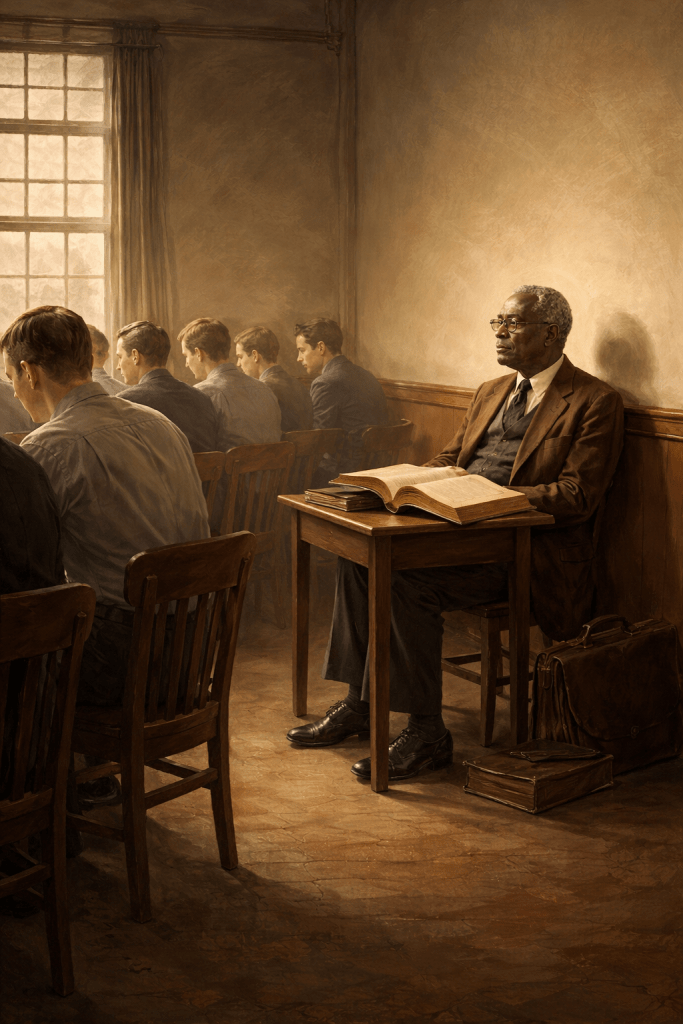
  • In 1948, a silent revolution walked into a classroom at the University of Oklahoma. His name was George McLaurin — a retired professor, a determined scholar, and a man who carried the weight of history on his shoulders.

    He was the first African American admitted to pursue a doctorate at the university. But admission did not mean acceptance.

    Because of segregation laws, McLaurin was forced to sit apart from his white classmates. In the classroom, he had a designated desk in a corner. In the cafeteria, he ate at a separate table. In the library, he was given a separate space. Physically present, yet socially isolated.

    But what happened next is what makes this story powerful.

    McLaurin did not allow isolation to define him. He later reflected that some classmates began to speak with him, to learn with him, and to slowly see beyond the barriers imposed by law. He observed something profound: the separation did not isolate him as much as it isolated those who enforced it. While he was gaining knowledge, growing intellectually, and expanding his understanding, those who excluded him were confined by their own prejudice.

    He wrote that the segregation gave him a unique clarity — he could see the difference between ignorance and education more sharply than ever before. The very system meant to diminish him only strengthened his perspective.

    There is something deeply moving about this image: a man seated alone, yet rising above everyone in wisdom. Not through anger. Not through rebellion. But through excellence.

    George McLaurin’s story reminds us that sometimes progress does not arrive with loud applause. Sometimes it enters quietly, sits in the corner, and changes the world simply by refusing to give up.

    He was separated physically, but never separated from his purpose.

    And history remembers exactly where he sat.

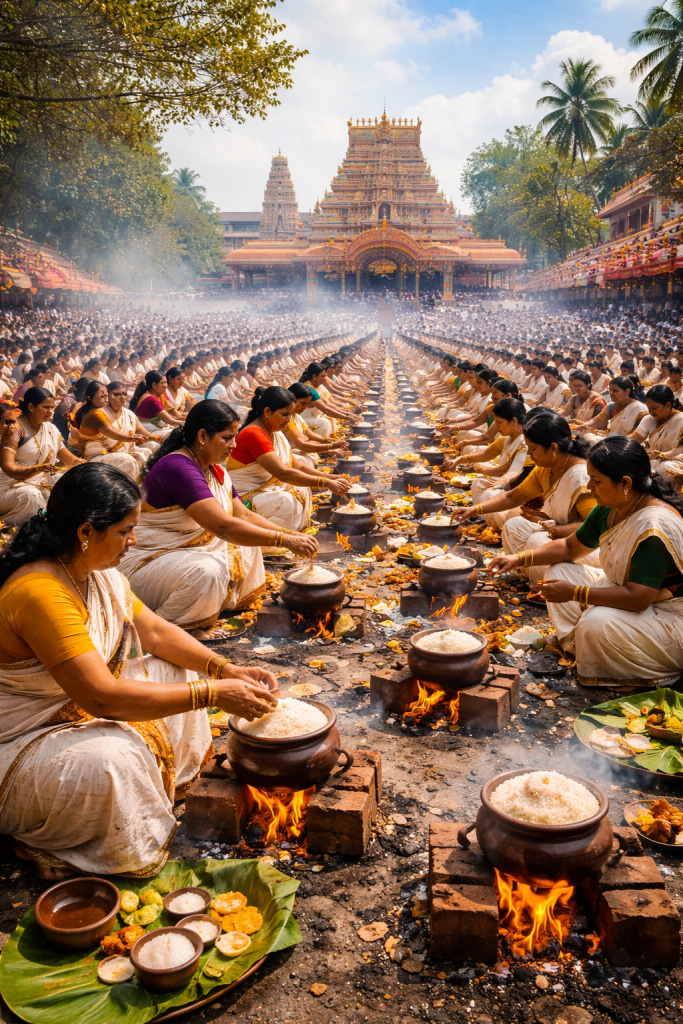
  • There are festivals, and then there are moments in history when faith itself seems to rise like a living flame. Attukal Pongala Maholsavam is not just a celebration—it is a powerful expression of devotion that transforms an entire city into a sacred space of unity, prayer, and strength.

    Held annually at the revered Attukal Bhagavathy Temple in Thiruvananthapuram, this extraordinary festival is dedicated to Goddess Attukal Amma, believed to be an incarnation of Kannaki, the symbol of purity and divine justice. What makes this festival remarkable is not grandeur in decoration or sound—but the silent, disciplined ocean of women who gather with one shared intention: offering.

    On the day of Pongala, millions of women line the streets, courtyards, terraces, and every possible open space across the city. Clay pots are arranged carefully over makeshift brick stoves. Rice, jaggery, coconut, and ghee are prepared with reverence. When the sacred flame is lit from the temple and passed from one hearth to another, a city breathes together. Fire spreads not in chaos—but in devotion.

    It is often recognized by the Guinness World Records as one of the largest gatherings of women for a religious event. Yet numbers alone cannot define it. The real power of Attukal Pongala lies in its discipline, silence, patience, and faith. There is no competition. No rush. Only surrender.

    For hours, women sit beside their pots under the open sky—praying, reflecting, enduring the heat of both the sun and the fire. When the offering is ready and blessed, it becomes more than sweet rice. It becomes gratitude. It becomes hope. It becomes strength carried back home.

    In a world that often measures power in noise and dominance, Attukal Pongala Maholsavam reminds us that true power can also be gentle, collective, and deeply spiritual. It shows how tradition, when rooted in belief and unity, can hold generations together.

    It is not merely a festival you witness. It is an experience you feel—in the warmth of the flame, in the fragrance of jaggery and ghee, and in the quiet determination of millions of women whose devotion turns an entire city into a temple.

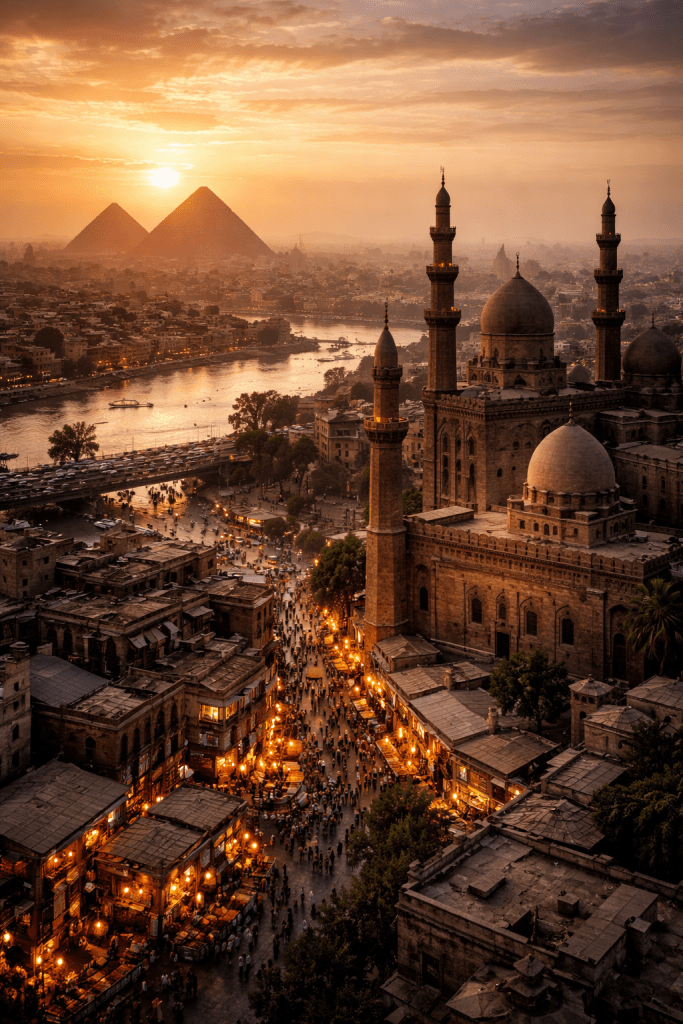
  • Cairo is not just a city you visit. It is a city you feel in your bones. The moment you step into Cairo, you realize you are standing in a place where history is not locked inside museums — it walks beside you in the streets, echoes in the call to prayer, and rises in stone against the desert sky.

    On the edge of the city stand the timeless Great Pyramids of Giza, silent yet powerful. They are not just monuments; they are declarations. Built thousands of years ago, they still command respect in a world obsessed with speed and shortcuts. They remind us that greatness is not rushed. It is engineered with patience, vision, and belief.

    Flowing through the heart of Cairo is the eternal Nile River. Civilizations were born on its banks. Empires rose and fell around it. Yet the river continues its journey — calm, steady, unstoppable. Much like Cairo itself. The city has witnessed conquests, revolutions, transformations, and still it stands — layered, complex, alive.

    Walk through the narrow lanes of Khan el-Khalili and you will find more than markets. You will find stories. Spices fill the air. Lanterns glow like captured stars. Voices bargain not just over goods, but over heritage. It is chaos, but it is meaningful chaos — a rhythm only Cairo understands.

    In the distance, the citadel built by Saladin watches over the city from the heights. It stands as a reminder that leadership is about vision and protection, about building something that outlives your lifetime. Cairo is full of such reminders — that true legacy is carved in stone, not written in temporary trends.

    Yet Cairo is not trapped in the past. Beneath the ancient skyline, modern life pulses intensely. Traffic roars. Conversations flow endlessly. Cafés are filled with thinkers, dreamers, entrepreneurs, and families. It is a city of resilience. A city of contradiction. A city where tradition and ambition shake hands every single day.

    Cairo teaches a powerful lesson: endurance builds identity. While many cities reinvent themselves every decade, Cairo carries its centuries with pride. It does not erase its past to look modern. It builds upon it.

    To visit Cairo is to confront time itself. It humbles you. It inspires you. It reminds you that greatness is not about noise — it is about permanence.

    And long after trends fade and headlines change, Cairo will remain — standing tall between desert and river, whispering the same message it has carried for thousands of years:

    Build something that lasts.

  • In every organization, there are boards that decide profits, policies, partnerships, and power moves. But very few build what I call a Board of Peace.

    A Board of Peace is not a formal committee. It doesn’t appear in annual reports. It isn’t registered under any corporate structure. Yet, it determines whether a company grows with stability or collapses under ego.

    A Board of Peace is a circle of minds that protect clarity.

    It is where decisions are not driven by panic, pride, or politics — but by principle. It is where difficult conversations happen without raised voices. Where disagreements are handled with maturity. Where silence is respected as much as speech.

    In business, especially in high-pressure environments — trading floors, export negotiations, real estate deals — chaos is always knocking at the door. Deadlines. Delays. Market volatility. Human error. Competition. Fear.

    Without peace at the decision table, speed becomes recklessness. Confidence becomes arrogance. Ambition becomes aggression.

    But when peace sits at the board, something powerful happens.

    Listening improves. Reactions slow down. Thinking sharpens. Long-term vision overrides short-term emotion. And strategy becomes sustainable.

    A Board of Peace does not avoid conflict — it manages it with dignity.

    It understands that growth without inner balance is dangerous. That money without mental discipline is unstable. That expansion without emotional control is temporary.

    The strongest leaders are not those who dominate the table.

    They are the ones who stabilize it.

    They don’t rush decisions to impress. They don’t speak to intimidate. They don’t argue to win. They guide to build.

    A peaceful boardroom creates resilient companies. It builds cultures where employees feel secure, partners feel respected, and investors feel confident.

    In the end, businesses don’t just fail because of bad strategies. They fail because of unstable minds behind good strategies.

    So build your Board of Peace.

    Surround yourself with people who question without attacking. Who challenge without humiliating. Who think long-term when others panic short-term.

    Because in a noisy world, peace is not weakness.

    It is the highest form of strength.

    And every great empire was first governed by a calm mind before it was ruled by power.

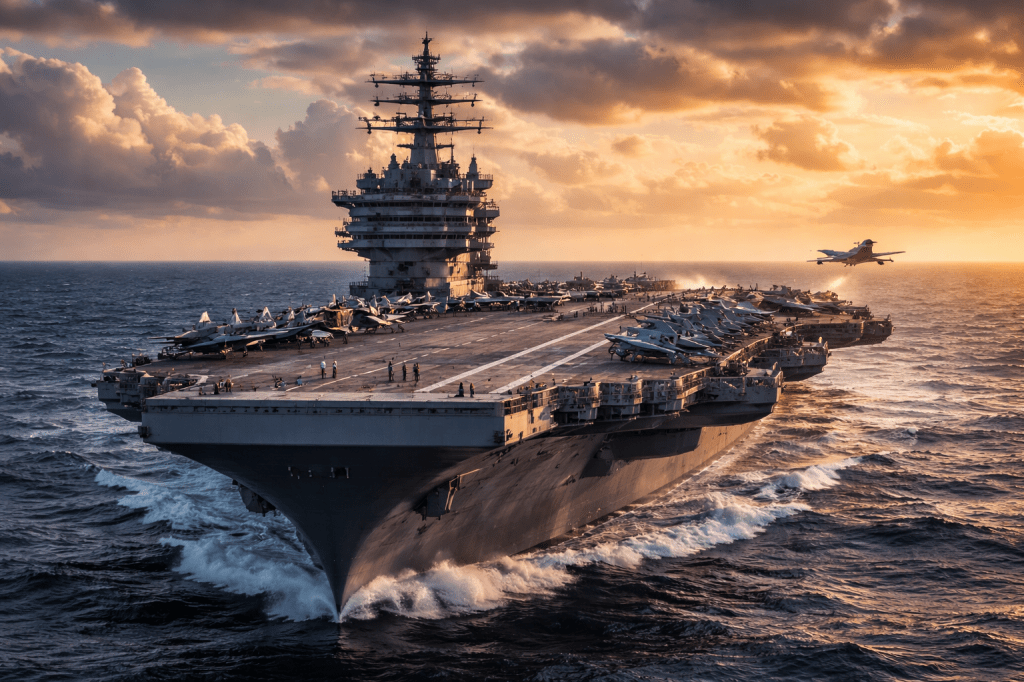
  • The USS Abraham Lincoln is not just a warship — it is a symbol of strategy, strength, and silent dominance that sails across the world’s oceans. Named after one of America’s most respected presidents, this nuclear-powered aircraft carrier represents more than military hardware; it represents presence. Wherever it moves, the world notices.

    Commissioned in 1989, this Nimitz-class supercarrier is powered by two nuclear reactors, allowing it to operate for over two decades without refueling. That means endurance. That means reach. That means the ability to remain deployed far from home shores, projecting power when and where it is needed. At over 1,000 feet in length, it is essentially a floating city — housing thousands of sailors and airmen, advanced aircraft squadrons, and some of the most sophisticated defense systems ever built.

    The USS Abraham Lincoln has participated in major global operations, from the Middle East to the Pacific. It has supported combat missions, humanitarian assistance, disaster relief, and strategic deterrence efforts. Its flight deck is a stage where fighter jets launch within seconds, transforming steel and ocean into speed and air dominance. Every launch and landing represents coordination, discipline, and precision.

    But beyond the technology and firepower lies something deeper — symbolism. Aircraft carriers like the Abraham Lincoln are instruments of diplomacy as much as defense. Their presence can reassure allies, deter adversaries, and stabilize tense regions without a single shot being fired. In modern geopolitics, visibility itself becomes influence.

    Thousands of crew members operate as one organism — engineers maintaining propulsion systems, pilots preparing for missions, deck crews managing aircraft movements, command officers coordinating global strategy. It is a living ecosystem of discipline and teamwork. Every day at sea reflects planning, training, and readiness.

    In a world where power dynamics shift rapidly, the USS Abraham Lincoln remains a reminder that naval supremacy is not just about force — it is about sustained capability, preparedness, and the ability to respond instantly. It sails not merely as steel and machinery, but as a statement: strength is most effective when it is steady, visible, and controlled.