Ballari, a historic city in northern Karnataka, stands as a powerful reminder that land itself can carry the memory of centuries. Known for its striking red soil, rugged granite hills, and rich mineral resources, Ballari is a place where nature, history, and industry intersect in remarkable ways. The city breathes a quiet strength, shaped by ancient dynasties, colonial footprints, and the relentless rhythm of mining and trade.
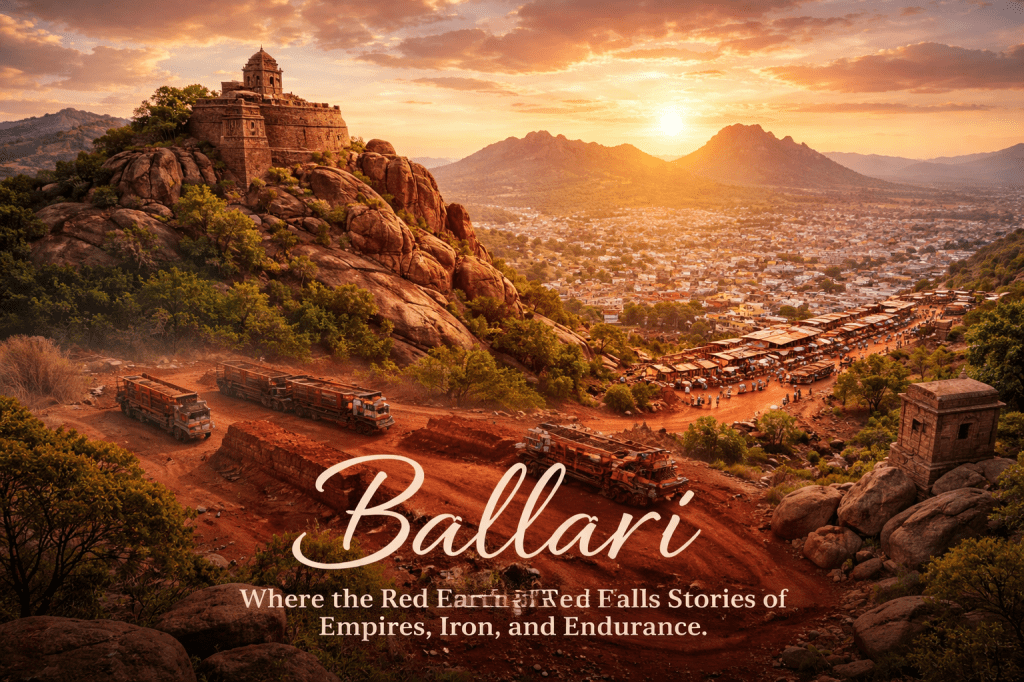
The landscape of Ballari is dramatic and raw. Massive rocky hills rise abruptly from the plains, giving the region a distinctive character unlike the lush greenery that much of Karnataka is known for. These hills have witnessed the rise and fall of kingdoms, the march of armies, and the transformation of a small settlement into one of India’s most significant mining hubs. The red dust that often hangs in the air is not merely soil; it is iron-rich earth that has powered industries and economies for decades.
History echoes through Ballari’s stones. The region once flourished under the rule of the Vijayanagara Empire, whose capital Hampi lies not far away. Merchants, soldiers, and scholars once moved across these lands, building temples, forts, and trading routes that connected South India with distant parts of the world. Even today, remnants of old fortifications and historic structures stand silently on hilltops, watching over the expanding city below.
Beyond its historical identity, Ballari is deeply tied to India’s iron ore story. For many years, the district has been one of the country’s most important mining regions. The earth beneath its surface holds vast deposits of iron ore, turning the area into a major center for extraction, trade, and transport. Trucks loaded with ore travel across highways, linking mines to ports and steel plants. This industrial pulse has shaped the local economy, attracting workers, entrepreneurs, and traders from different parts of the country.
Yet Ballari is not only about minerals and machines. Life here moves with the resilience of its people. Markets buzz with traders selling grains, textiles, and traditional foods. Small tea stalls become places where conversations about politics, agriculture, and daily struggles blend together. The Kannada language dominates daily life, but you can also hear Telugu, Urdu, and Hindi, reflecting the region’s diverse cultural fabric.
The climate of Ballari is harsh compared to the coastal parts of Karnataka. Summers can be intensely hot, and the land often appears dry and sunburnt. But the people of the region have long adapted to these conditions, cultivating crops like groundnuts, cotton, and millets. Their lives reflect a deep understanding of the land’s strengths and limitations.
What makes Ballari truly fascinating is its contrast. Ancient history stands beside modern industry. Quiet villages exist alongside bustling mining zones. Harsh landscapes hold hidden beauty during sunrise and sunset, when the rocky hills glow with shades of gold and crimson. The city may not always appear on typical tourist maps, but for those who take the time to understand it, Ballari reveals a story of endurance, transformation, and identity.
In many ways, Ballari represents the spirit of interior India—unpolished yet powerful, challenging yet rewarding. It is a land where the earth is rich with minerals, the past is carved into stone, and the future continues to be shaped by the hands of people who call this rugged terrain their home.

 Histopedia
Leave a reply to cat9984 Cancel reply