China is quietly rewiring its future—not through diplomacy or military alliances, but through electricity. At a time when the world watches the Middle East with growing anxiety, Beijing is building something far more powerful than oil reserves: a “supergrid” designed to insulate its economy from global energy shocks and redraw the balance of power in the energy world.
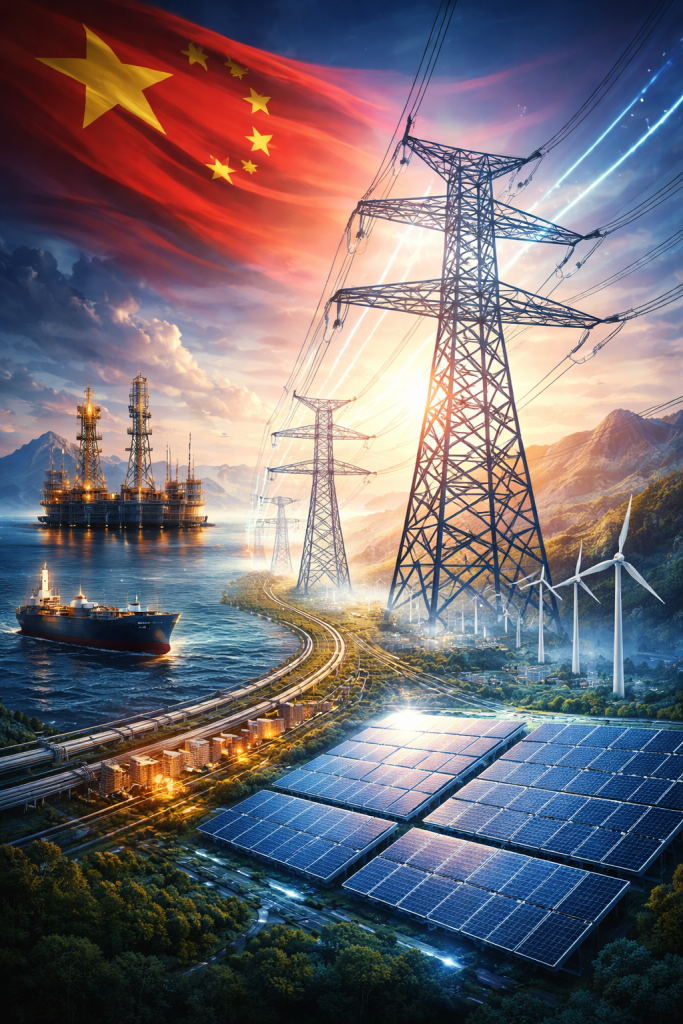
For decades, China’s rise has been fueled by imported oil, much of it flowing through fragile geopolitical chokepoints. Nearly half of its crude imports depend on routes tied to the Middle East, making any conflict in the region a direct threat to its economic stability. (The Asia Group) The ongoing tensions and disruptions in global oil supply chains have only sharpened this vulnerability, reminding Beijing of a hard truth—energy dependence is strategic weakness.
China’s answer is bold: reduce reliance on oil by transforming how energy is produced, transmitted, and consumed. At the heart of this transformation lies the supergrid—an ultra-high-voltage electricity network capable of transmitting power across thousands of kilometers with minimal loss. These grids connect remote renewable energy sources like deserts, mountains, and rivers to the country’s industrial heartlands, effectively turning geography into an advantage rather than a limitation.
This isn’t just an infrastructure project; it’s a structural shift. China has spent years investing heavily in power grid expansion to absorb renewable energy and reduce dependence on imported fuels. (The Straits Times) Massive transmission lines now carry electricity generated from wind farms in Xinjiang, hydropower in Sichuan, and solar parks in Inner Mongolia to cities on the eastern coast. Projects like ultra-high-voltage direct current (UHVDC) lines are capable of moving gigawatts of electricity over thousands of kilometers, forming the backbone of this emerging supergrid.
The implications are profound. By electrifying more of its economy—transport, industry, and even heating—China can gradually replace oil consumption with domestically generated power. Already, the shift toward electric vehicles and renewable energy has begun reducing oil demand, with some estimates suggesting a measurable decline in consumption. At the same time, global crises like the current Middle East conflict are accelerating investments in clean energy, not just in China but worldwide.
What makes the supergrid strategy particularly powerful is its dual benefit. On one hand, it strengthens energy security by reducing exposure to volatile oil markets and geopolitical risks. On the other, it positions China as a global leader in renewable technology and infrastructure—exporting not just goods, but systems and standards.
Historically, China’s biggest energy fear has been the so-called “Malacca dilemma”—the risk that critical oil shipments could be blocked at narrow maritime chokepoints. Today, the supergrid represents a way out of that trap. Instead of securing oil routes, China is reducing the need for them altogether.
In a world still shaped by oil politics, China is betting on electricity as the new currency of power. The supergrid is more than cables and towers—it is a strategic shield, an economic engine, and a signal to the world that the future of energy may not flow through pipelines, but through wires.
While the world fights over oil routes, China is quietly building a future where energy flows through power lines—not geopolitics.
 Histopedia
Leave a comment