There was a time when Korea was one—one land, one culture, one people, living with a shared identity that had evolved over centuries. That unity was shattered in 1910 when Japan annexed Korea, beginning decades of colonial rule that suppressed Korean language, culture, and independence. For 35 years, Korea existed under foreign control, waiting for the moment when it could reclaim its freedom. That moment finally came in 1945 with the end of World War II, when Japan surrendered and withdrew from the peninsula. But instead of a fully independent and unified Korea, a new and unexpected reality emerged—one shaped not by Koreans, but by global superpowers.
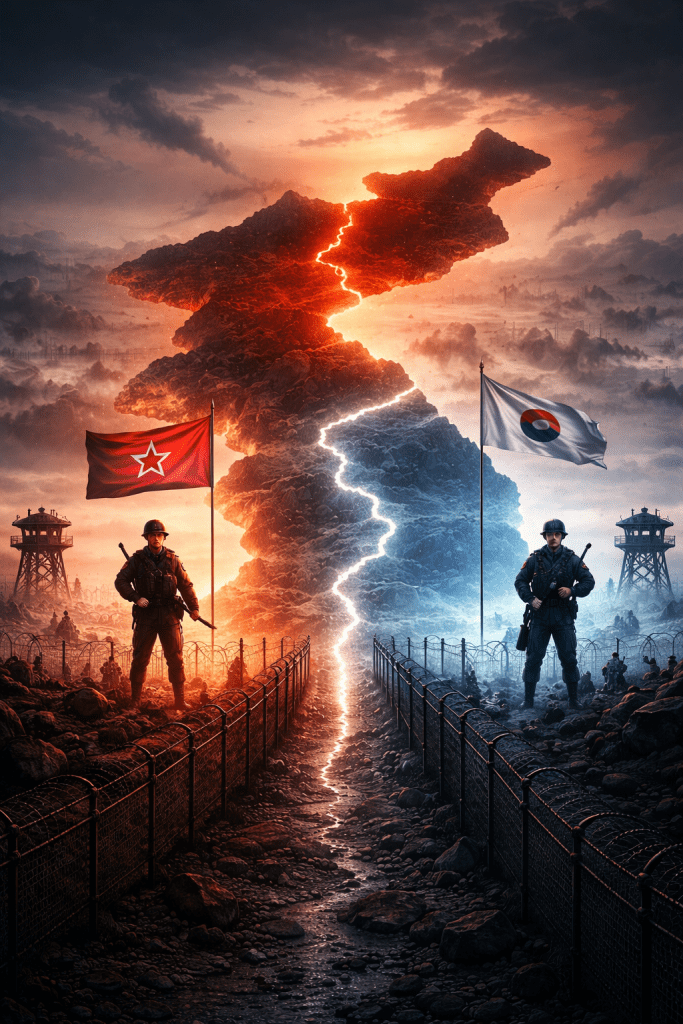
In the immediate aftermath of the war, the United States and the Soviet Union stepped in to manage the transition. With urgency and little consultation, they decided to divide Korea along the 38th parallel, a line that had no cultural or historical significance to the Korean people. The northern half came under Soviet influence, while the southern half was administered by the United States. What was intended to be a temporary arrangement soon began to solidify into something far more permanent. Political systems were established, ideologies took root, and by 1948, two separate governments had emerged—each claiming legitimacy over the entire peninsula.
In the north, Kim Il-sung established a communist regime, forming the Democratic People’s Republic of Korea. In the south, Syngman Rhee led the creation of the Republic of Korea, built on democratic and capitalist principles. The division was no longer just geographical—it had become ideological. Two systems, two visions, and two futures began to develop side by side, each incompatible with the other. Tensions grew rapidly, and by 1950, those tensions exploded into open conflict with the outbreak of the Korean War, when North Korean forces crossed the 38th parallel in an attempt to unify the peninsula under their rule.
The war quickly escalated beyond a civil conflict, becoming a proxy battle in the larger Cold War struggle. The United Nations, led by the United States, intervened in support of the South, while the North received backing from the Soviet Union and China. The fighting was brutal and devastating, claiming millions of lives and leaving cities in ruins. Families were torn apart in the chaos, many separated with no way of ever reconnecting. After three years of destruction, an armistice was signed in 1953, effectively ending active combat but not the war itself. No formal peace treaty was ever concluded, leaving the two Koreas technically still at war to this day.
The line that once seemed temporary became one of the most fortified borders in the world—the Demilitarized Zone, or DMZ. On one side stands North Korea, a state defined by strict control and isolation. On the other stands South Korea, a nation that has grown into a global economic and cultural force. Despite their shared history, language, and heritage, the differences between them have become stark and profound. Yet beyond the politics and military tensions lies a quieter, more human tragedy—families separated for decades, parents who never saw their children again, and generations who grew up without knowing their own blood.
The division of Korea is not just a story of war or ideology; it is a reminder of how decisions made in distant rooms can reshape the lives of millions. A single line, drawn in haste, turned one nation into two, creating a legacy that continues to define the Korean Peninsula even today. And in that reality lies a powerful truth—sometimes, history does not simply pass; it stays, living on in borders, in memories, and in the silence between those who were once one.
 Histopedia
Leave a comment