The tensions between Iran, Israel, and the United States have once again brought the world’s attention to the fragile balance of power in the Middle East. What appears on the surface as a sudden military confrontation is, in reality, the result of decades of mistrust, political rivalry, and competing visions for regional dominance.
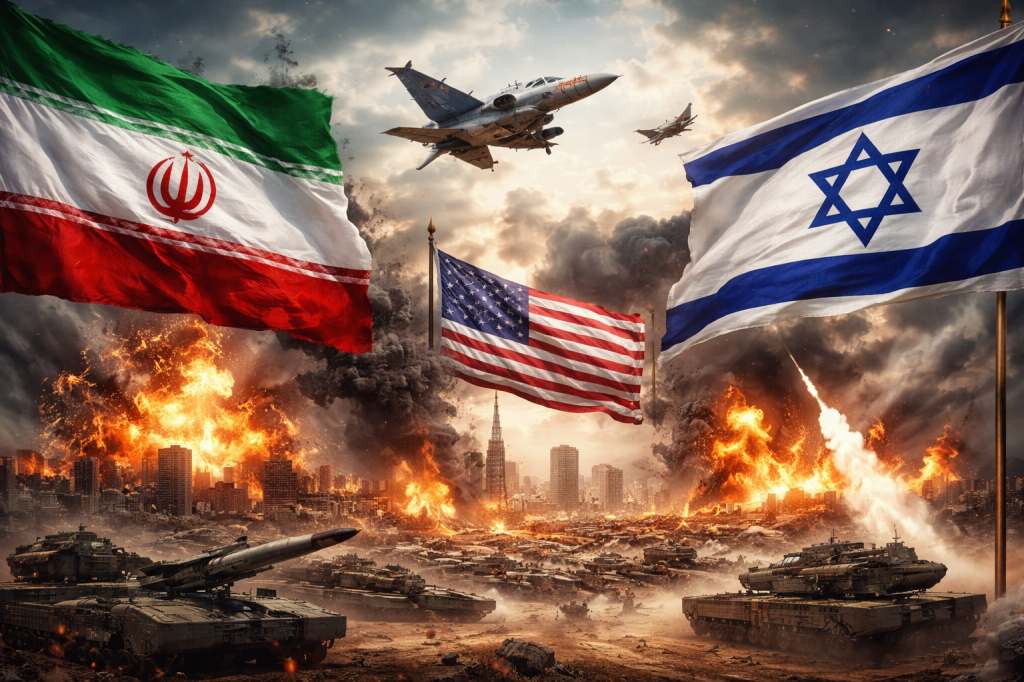
The relationship between Iran and Israel has been deeply hostile since the 1979 Iranian Revolution, when Iran’s new leadership openly opposed Israel and its Western allies. Over time, this hostility expanded into a complex geopolitical struggle. Israel has consistently viewed Iran’s nuclear ambitions and missile programs as an existential threat, while Iran has framed Israel as a symbol of Western influence in the region. The United States, a long-time ally of Israel, has often positioned itself at the center of this rivalry, imposing sanctions on Iran and supporting efforts to curb its military capabilities.
Recent events have intensified this long-standing conflict. In early 2026, coordinated military strikes by Israel and the United States targeted Iranian military infrastructure and nuclear facilities across several cities. These operations aimed to weaken Iran’s military strength and halt its nuclear development program. The strikes also eliminated several senior Iranian officials and military commanders, dramatically escalating tensions.
Iran responded with missile and drone attacks directed at Israeli territory and American military bases across the Gulf region. The conflict quickly expanded beyond national borders, with strikes and security alerts reported in several Middle Eastern countries. Strategic locations such as the Strait of Hormuz — one of the most important oil transit routes in the world — became flashpoints of geopolitical tension, raising fears about disruptions to global energy supplies.
Beyond the battlefield, the consequences of the conflict ripple through the global economy and international diplomacy. Oil prices fluctuate as markets react to uncertainty in the Gulf. Airlines reroute flights as regional airspace becomes unsafe. Governments around the world call for restraint, fearing that a prolonged conflict could destabilize not only the Middle East but also the global economic system.
Yet, beneath the military operations and political statements lies a deeper reality: this conflict is not only about territory or weapons. It is about influence, ideology, and the future balance of power in the region. For Iran, it represents resistance against Western dominance. For Israel, it is framed as a matter of survival and security. For the United States, it reflects strategic interests in maintaining stability and protecting allies.
History shows that conflicts in the Middle East rarely remain isolated events. They tend to reshape alliances, redefine global strategies, and remind the world how interconnected geopolitics truly is. As the Iran–Israel–U.S. tensions continue to unfold, the world watches closely, hoping diplomacy will eventually replace missiles and that dialogue will succeed where confrontation has repeatedly failed.
 Histopedia
Leave a comment