In 1948, a silent revolution walked into a classroom at the University of Oklahoma. His name was George McLaurin — a retired professor, a determined scholar, and a man who carried the weight of history on his shoulders.
He was the first African American admitted to pursue a doctorate at the university. But admission did not mean acceptance.
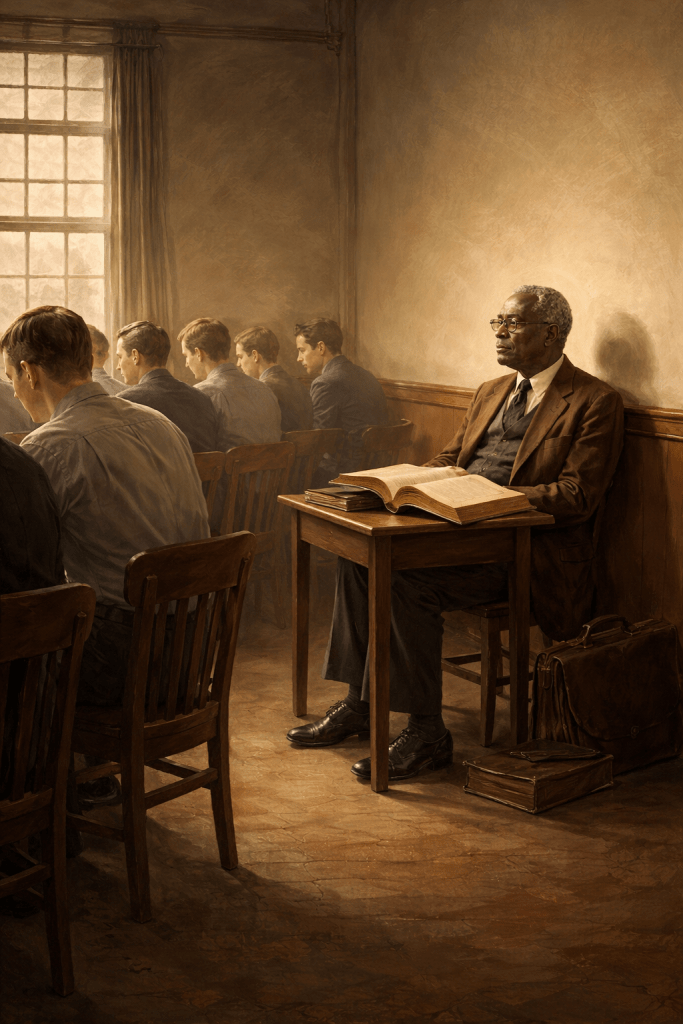
Because of segregation laws, McLaurin was forced to sit apart from his white classmates. In the classroom, he had a designated desk in a corner. In the cafeteria, he ate at a separate table. In the library, he was given a separate space. Physically present, yet socially isolated.
But what happened next is what makes this story powerful.
McLaurin did not allow isolation to define him. He later reflected that some classmates began to speak with him, to learn with him, and to slowly see beyond the barriers imposed by law. He observed something profound: the separation did not isolate him as much as it isolated those who enforced it. While he was gaining knowledge, growing intellectually, and expanding his understanding, those who excluded him were confined by their own prejudice.
He wrote that the segregation gave him a unique clarity — he could see the difference between ignorance and education more sharply than ever before. The very system meant to diminish him only strengthened his perspective.
There is something deeply moving about this image: a man seated alone, yet rising above everyone in wisdom. Not through anger. Not through rebellion. But through excellence.
George McLaurin’s story reminds us that sometimes progress does not arrive with loud applause. Sometimes it enters quietly, sits in the corner, and changes the world simply by refusing to give up.
He was separated physically, but never separated from his purpose.
And history remembers exactly where he sat.
 Histopedia
Leave a comment