The USS Abraham Lincoln is not just a warship — it is a symbol of strategy, strength, and silent dominance that sails across the world’s oceans. Named after one of America’s most respected presidents, this nuclear-powered aircraft carrier represents more than military hardware; it represents presence. Wherever it moves, the world notices.
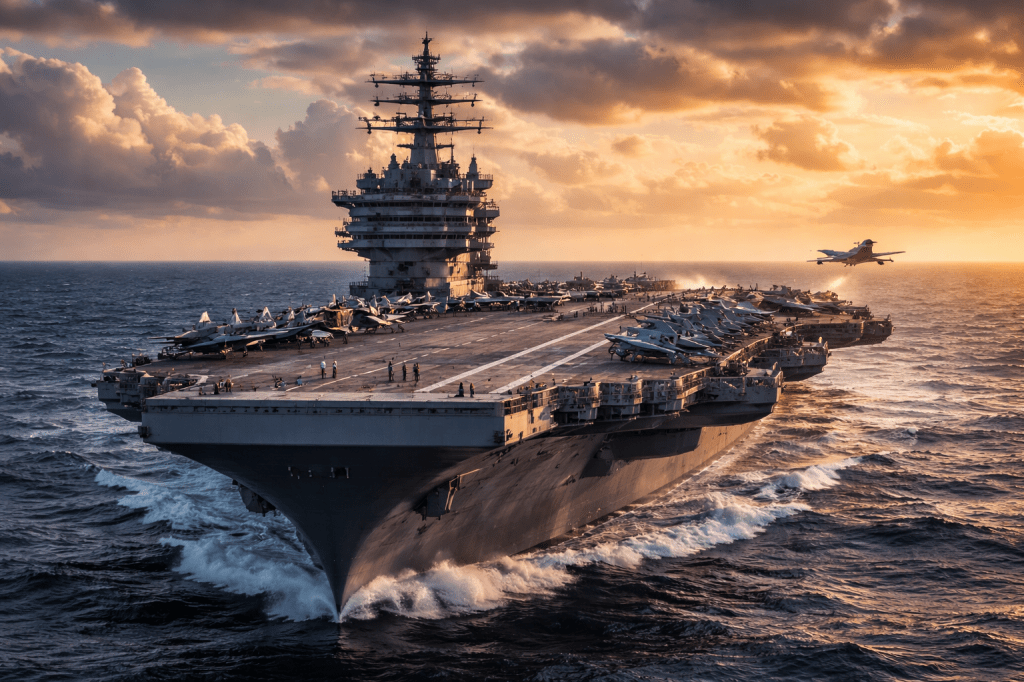
Commissioned in 1989, this Nimitz-class supercarrier is powered by two nuclear reactors, allowing it to operate for over two decades without refueling. That means endurance. That means reach. That means the ability to remain deployed far from home shores, projecting power when and where it is needed. At over 1,000 feet in length, it is essentially a floating city — housing thousands of sailors and airmen, advanced aircraft squadrons, and some of the most sophisticated defense systems ever built.
The USS Abraham Lincoln has participated in major global operations, from the Middle East to the Pacific. It has supported combat missions, humanitarian assistance, disaster relief, and strategic deterrence efforts. Its flight deck is a stage where fighter jets launch within seconds, transforming steel and ocean into speed and air dominance. Every launch and landing represents coordination, discipline, and precision.
But beyond the technology and firepower lies something deeper — symbolism. Aircraft carriers like the Abraham Lincoln are instruments of diplomacy as much as defense. Their presence can reassure allies, deter adversaries, and stabilize tense regions without a single shot being fired. In modern geopolitics, visibility itself becomes influence.
Thousands of crew members operate as one organism — engineers maintaining propulsion systems, pilots preparing for missions, deck crews managing aircraft movements, command officers coordinating global strategy. It is a living ecosystem of discipline and teamwork. Every day at sea reflects planning, training, and readiness.
In a world where power dynamics shift rapidly, the USS Abraham Lincoln remains a reminder that naval supremacy is not just about force — it is about sustained capability, preparedness, and the ability to respond instantly. It sails not merely as steel and machinery, but as a statement: strength is most effective when it is steady, visible, and controlled.
 Histopedia
Leave a comment