In 1972, the world witnessed one of the most dramatic economic and humanitarian decisions in modern history. Under the rule of Idi Amin, nearly 80,000 Indians living in Uganda were ordered to leave the country within just 90 days. What was presented as a political move rooted in nationalism soon revealed itself as a decision that would deeply scar a nation’s economy.
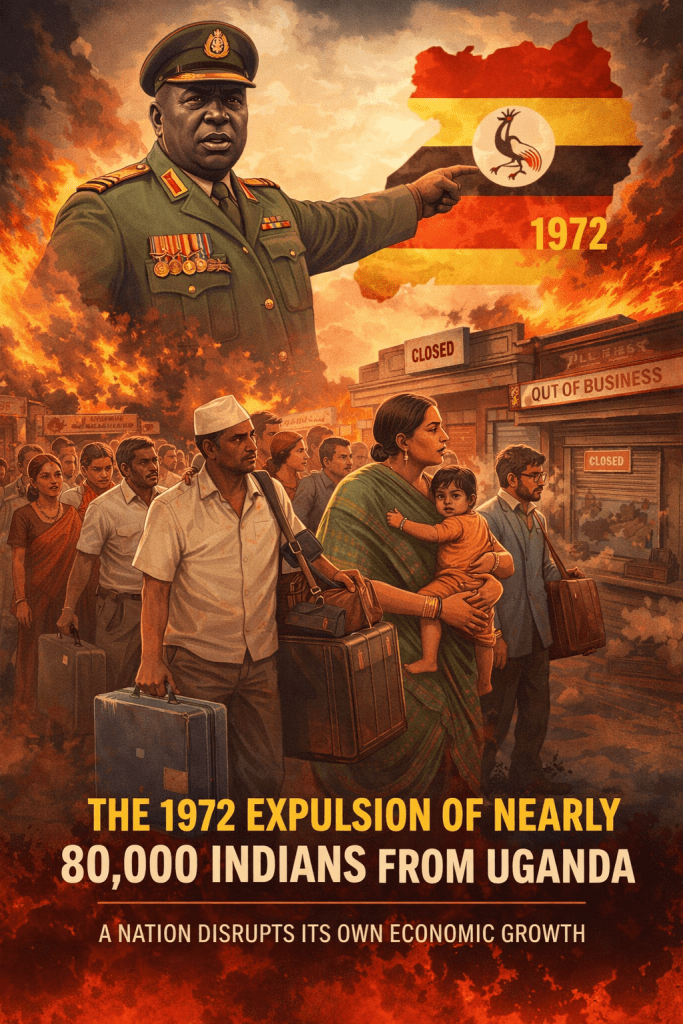
For decades, the Indian community had been a backbone of Uganda’s commercial ecosystem. They were traders, industrialists, manufacturers, and small business owners who built strong supply chains, managed distribution networks, and kept markets functioning smoothly. From retail shops to large-scale enterprises, their contribution was not just visible — it was foundational.
When the expulsion order came, businesses were seized, bank accounts frozen, and properties taken over. In a matter of weeks, Uganda lost a significant portion of its entrepreneurial class. Supply chains collapsed. Production slowed. Essential goods became scarce. The intricate web that connected farmers, transporters, wholesalers, and retailers began to unravel.
Economic decisions are never isolated events. They ripple across generations. The removal of experienced business communities created a vacuum that was not easily filled. Industries struggled without leadership and expertise. Confidence in the market weakened. International relationships were strained. What was intended to empower the nation instead disrupted its economic rhythm.
History teaches us that economies thrive on inclusion, stability, and trust. When policy targets enterprise instead of empowering it, the cost is often far greater than anticipated. Nations grow when they protect their entrepreneurs, encourage diversity in commerce, and strengthen supply chains — not when they dismantle them.
The story of 1972 stands as a powerful reminder: economic strength is built over decades but can be destabilized in months. Leadership carries responsibility, and decisions taken in moments of political intensity can echo for generations.
Growth is not about exclusion. It is about building systems where every contributor has a place — and where progress is measured not by control, but by collective prosperity.
 Histopedia
Leave a comment