Look up at the sky and you’ll notice something interesting — almost every airplane is painted white. It has become the global standard in aviation. Yet, there is one airline that broke this tradition and chose a bold, powerful black. That airline is Air New Zealand.
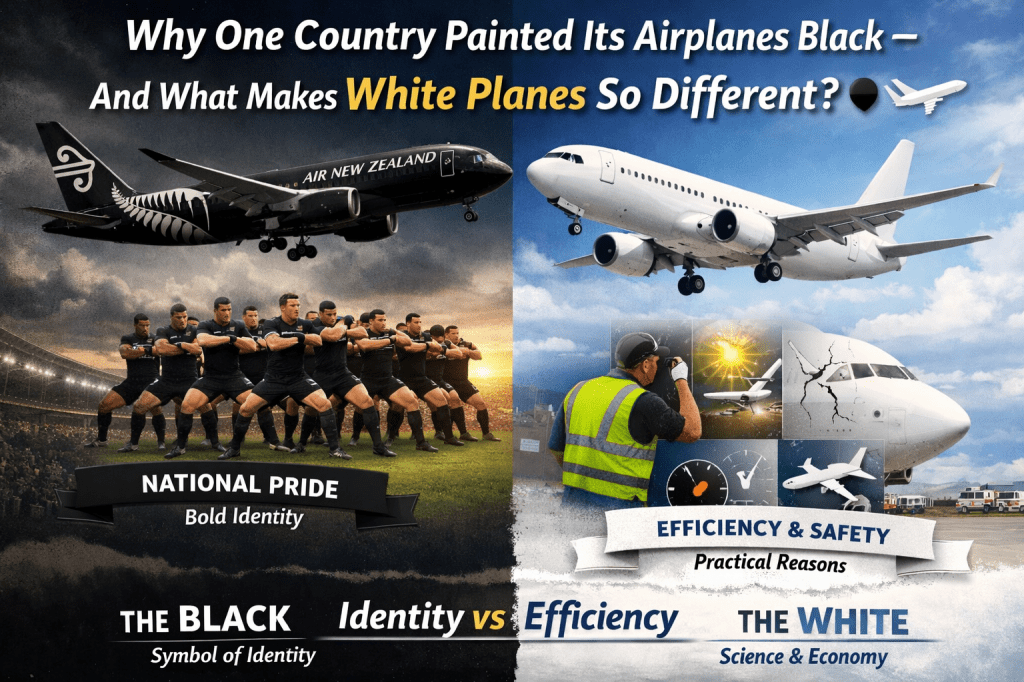
While most carriers prefer white for practical reasons, Air New Zealand introduced black aircraft as a tribute to national pride and identity. The colour reflects the spirit of New Zealand and its deep connection to the legendary All Blacks rugby team. The black livery quickly became iconic — not just a design choice, but a statement in the sky.
But why are airplanes usually white in the first place?
The answer is rooted in science and economics. White paint reflects sunlight. Aircraft spend long hours under direct sun — whether cruising above the clouds or parked on airport runways. A white surface helps reduce heat absorption, keeping the aircraft cooler and protecting internal systems from temperature stress. Over time, this improves efficiency and reduces maintenance strain.
White also makes inspections easier. Small cracks, oil leaks, dents, or corrosion marks are more visible on a light surface. In aviation, where safety is everything, easier inspection means faster detection and quicker maintenance decisions.
There’s also a cost factor. Paint adds weight to an aircraft, and in aviation, even a small increase in weight can affect fuel consumption. Lighter shades generally require less complex layering and may add slightly less weight compared to darker coatings. Over thousands of flights, these small differences translate into significant operational savings.
Another subtle advantage is durability. White paint fades less noticeably under constant exposure to sunlight. It also simplifies repainting when aircraft are sold or rebranded, which helps preserve resale value.
So what is the real difference between white and black airplanes?
Functionally, there is little difference in how they fly. The aircraft’s performance remains largely the same. The true distinction lies in purpose. White represents efficiency, safety, cost-effectiveness, and practicality. Black represents branding, bold identity, and emotional connection.
Air New Zealand chose identity over convention — and in doing so, turned an aircraft into a flying symbol. Most airlines choose white because it makes business sense. One chose black because it makes a statement.
The next time you see a white aircraft crossing the sky, remember — it’s not just a colour. It’s a decision shaped by science, safety, and strategy. And if you ever spot a black one, know that you’re witnessing a story painted across the clouds.
 Histopedia
Leave a comment