India is not just a country. It is a continuous civilization — layered, living, breathing through time. And now, that timeless journey finds a monumental home in the world’s largest museum, built to narrate 5,000 years of Indian civilization under a single roof.
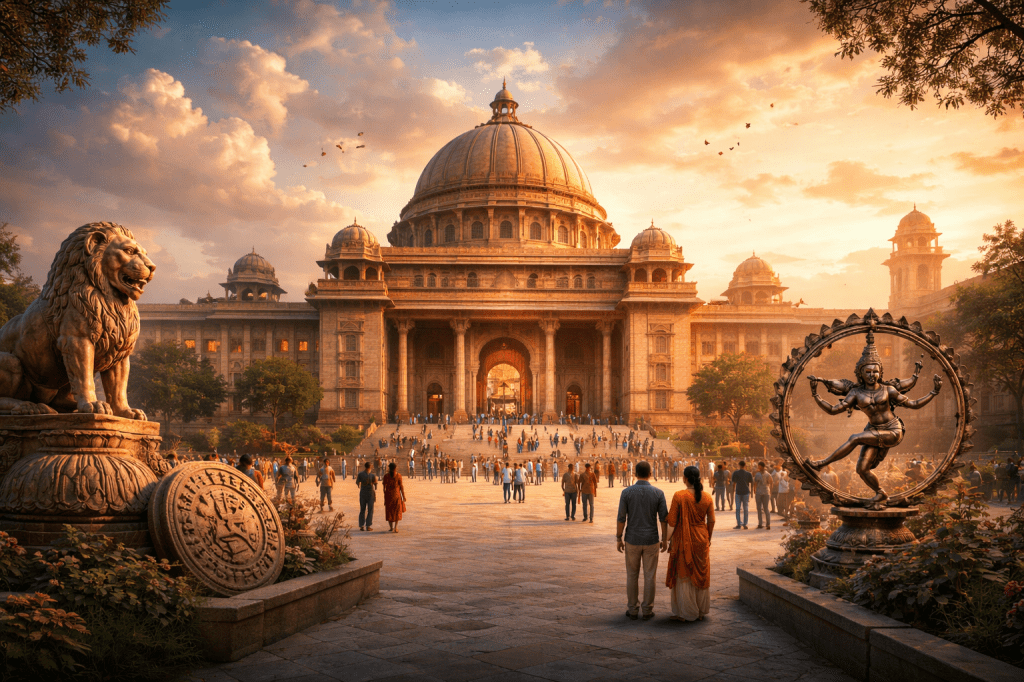
In the heart of New Delhi stands the iconic Yuge Yugeen Bharat National Museum, a visionary cultural landmark rising within the historic North Block and South Block buildings along Kartavya Path. What once symbolized colonial administration is now being transformed into a sanctuary of civilizational pride — a poetic reclamation of history.
This is not merely a museum. It is a narrative architecture. A civilizational archive. A time machine.
From the mysteries of the Indus Valley to the philosophical depth of the Vedic age, from the intellectual brilliance of ancient universities to the artistic magnificence of temple architecture, from the resilience of medieval India to the fire of the freedom movement, and into the aspirations of modern India — every era will breathe here.
The scale itself is staggering. Spanning over 1.5 million square feet, this museum is designed to surpass global institutions in size and storytelling depth. It is expected to house thousands of artifacts, immersive galleries, digital experiences, and thematic exhibitions that bring together archaeology, art, science, culture, governance, spirituality, and innovation.
But beyond numbers, what truly matters is meaning.
For decades, India’s story was fragmented across textbooks, museums, and narratives written through borrowed lenses. This museum seeks to tell the story from within — through Indian eyes, Indian memory, Indian consciousness.
It is an attempt to present Bharat not as a timeline of invasions and rulers, but as an unbroken flow of ideas, knowledge systems, traditions, and resilience.
Imagine walking through galleries where ancient scripts whisper forgotten wisdom. Where sculptures speak of devotion and mathematics meets astronomy in stone inscriptions. Where freedom fighters’ voices echo not as distant history, but as living inspiration. Where children don’t just see artifacts — they experience identity.
This is more than preservation. It is assertion.
In a world racing toward the future, India pauses — not to look back in nostalgia — but to draw strength from continuity. Because civilizations that remember, endure.
The world’s largest museum is not just a cultural project. It is a statement: that India’s story is vast, layered, and worthy of being told at the scale of its spirit.
Five thousand years. One civilization. One roof.
And the journey is just beginning.
 Histopedia
Leave a comment