When Japan unveils an innovation, it rarely does so for attention. It does it to redefine what’s possible. A bullet train without seats or windows may sound unusual at first — almost incomplete. But in Japan’s world of precision engineering, nothing is accidental. Every design choice carries purpose.
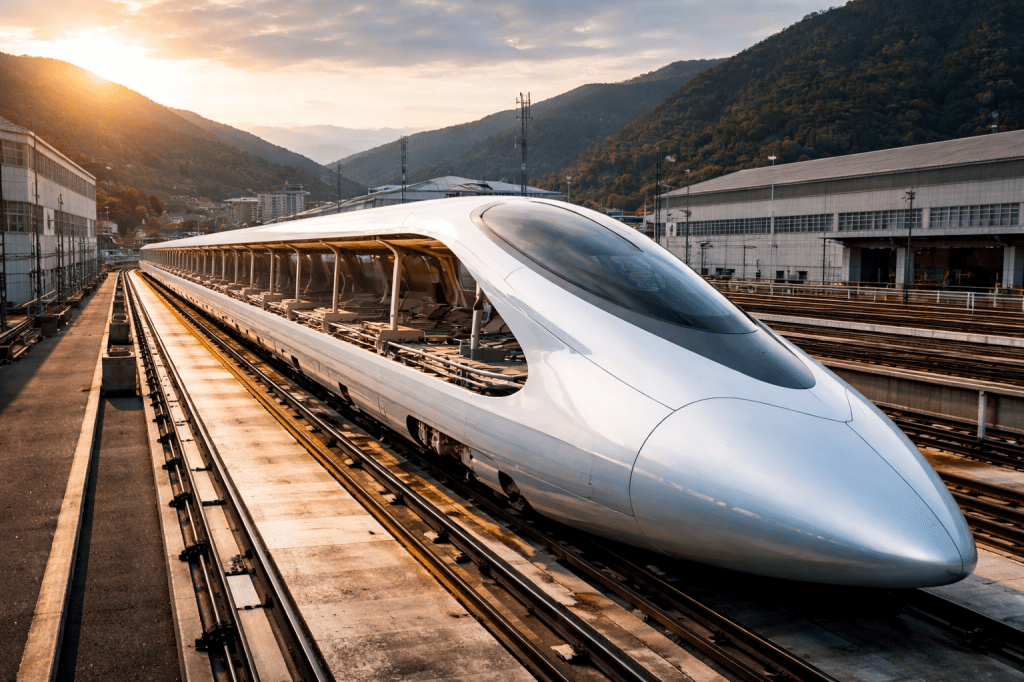
This concept is not built for passengers. It is a high-speed experimental model created to test the limits of performance, aerodynamics, and engineering efficiency. By removing seats, windows, and other interior components, engineers reduce weight significantly. Less weight means greater speed. Fewer structural interruptions mean smoother airflow. And smoother airflow means enhanced stability at extreme velocities.
Japan has always treated time as a discipline. The country’s rail network is famous not just for speed, but for punctuality measured in seconds. For them, innovation is not about comfort first — it is about mastery. Mastery over motion. Mastery over time.
A train without seats challenges our traditional idea of travel. We associate trains with journeys, views through windows, and comfort during transit. But this model is not about the journey we see — it is about the boundaries we break. It is a laboratory on rails, designed to push technology forward so that future passenger trains become faster, safer, and more efficient.
This is how Japan builds the future — quietly, precisely, and intentionally. They test boldly so that the final product feels effortless. They remove what is unnecessary to strengthen what truly matters.
Innovation is not always glamorous. Sometimes it looks empty. Sometimes it removes comfort before it improves it. But behind that emptiness is vision.
And that is the real story of a bullet train without seats or windows — not a train meant to carry people today, but a platform designed to carry possibilities tomorrow.
 Histopedia
Leave a comment