The United States did not become a superpower during the Second World War by accident—it engineered its rise with timing, resources, and ruthless clarity of strategy. While Europe and large parts of Asia were burning, American mainland industries were untouched. This single advantage allowed the U.S. to do what no other nation could at that moment: produce at scale without interruption. Factories that once made cars and household goods were rapidly converted into war machines, creating ships, aircraft, weapons, and supplies at a pace the world had never seen. War became an industrial operation, and America mastered it.
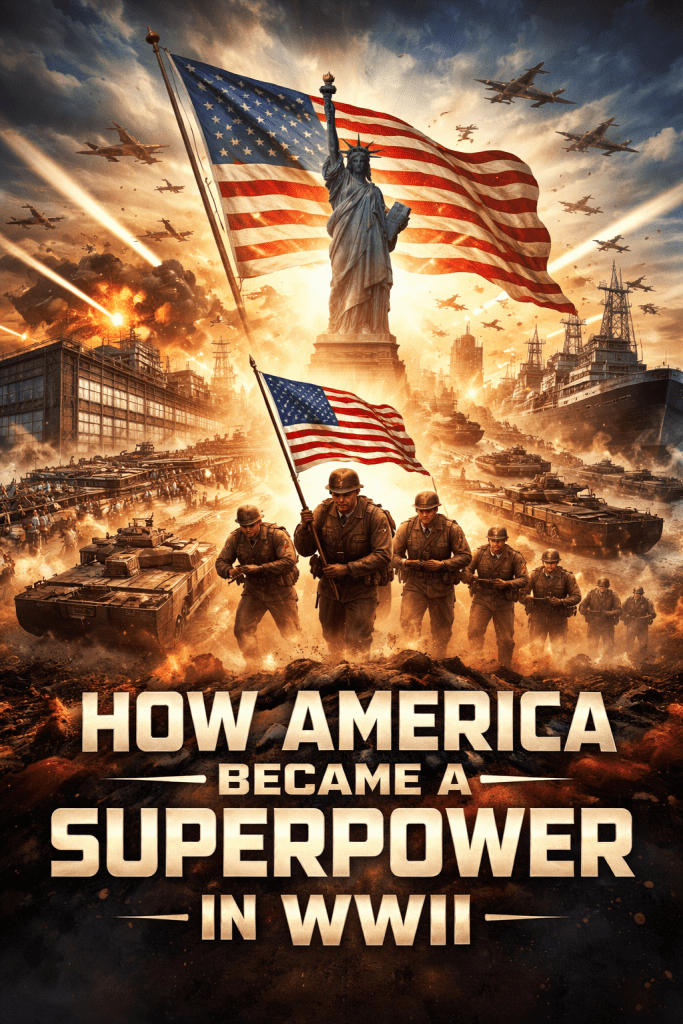
Before even entering the war directly, the U.S. positioned itself as the arsenal of democracy. Through programs like Lend-Lease, it supplied weapons, food, fuel, and machinery to Allied nations, especially Britain and the Soviet Union. This was not charity—it was strategy. While others exhausted their economies and manpower, the U.S. strengthened its industrial base, created millions of jobs, and tied the survival of other nations to American production and finance. Dollars, not just bullets, were shaping the outcome.
The war also forced the U.S. government, corporations, and scientists into a rare alignment. Massive public spending fueled private innovation. Universities, research labs, and industries worked together, leading to breakthroughs in aviation, logistics, medicine, and ultimately nuclear technology. The Manhattan Project alone signaled a shift in global power—America now possessed not just industrial strength, but unmatched technological supremacy.
Equally important was what happened after the war. Europe was devastated; its cities, infrastructure, and economies lay in ruins. The United States emerged physically intact, financially stronger, and militarily dominant. Using tools like the Marshall Plan, it rebuilt allies in its own image—capitalist, trade-linked, and dollar-dependent. At the same time, new global institutions such as the IMF, World Bank, and the United Nations were shaped largely by American interests, locking in influence without direct occupation.
World War II transformed the United States from a powerful nation into the central pillar of the global order. It learned that dominance was not only about winning battles, but about controlling production, finance, technology, and post-war recovery. In a world broken by conflict, America positioned itself as both the builder and the banker—and that is how a superpower was born.
 Histopedia
Leave a comment