When the world talks about speed, scale, and execution in rail infrastructure, one country consistently dominates the conversation — China.
China operates the largest and most advanced high-speed rail (HSR) network on the planet, and by every meaningful metric, it stands at No.1 globally.
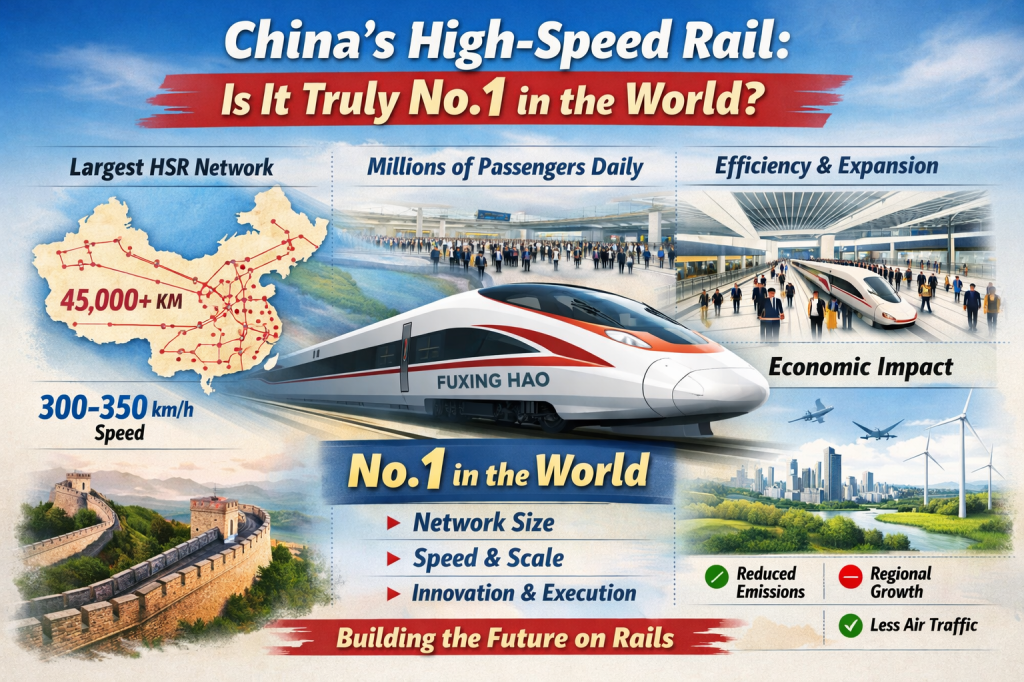
China’s high-speed rail network spans over 45,000 kilometers, more than the rest of the world combined. From megacities to remote provinces, high-speed trains connect regions that once took days to reach, now covered in hours. This isn’t just transportation; it’s national integration at scale.
Chinese high-speed trains regularly operate at 300–350 km/h, with experimental models pushing even further. Trains like the Fuxing Hao are fully designed and manufactured domestically, showcasing China’s technological independence and engineering depth.
What truly sets China apart is operational efficiency. Trains run with remarkable punctuality, high frequency, and massive daily passenger volumes. Stations function like airports, yet move people faster and more smoothly. Millions commute daily using high-speed rail as a normal part of life.
Compared to Japan’s Shinkansen or Europe’s fragmented rail systems, China leads in network size, expansion speed, cost efficiency, and state-level execution. While others pioneered the concept, China perfected the scale.
High-speed rail in China is not a luxury project — it is an economic engine. It boosts regional development, reduces air traffic congestion, lowers carbon emissions, and reshapes how cities grow.
So, is China No.1 in high-speed rail?
Yes — not just in speed, but in vision, scale, and impact.
China didn’t just build trains.
It built the future on rails. 🚄
 Histopedia
Leave a comment