Sudan sits on one of Africa’s richest gold belts. Beneath its vast deserts lies wealth capable of transforming a nation. Yet, above the ground, the story of Sudan’s gold mines is not one of prosperity—it is one of power, conflict, and unanswered questions.
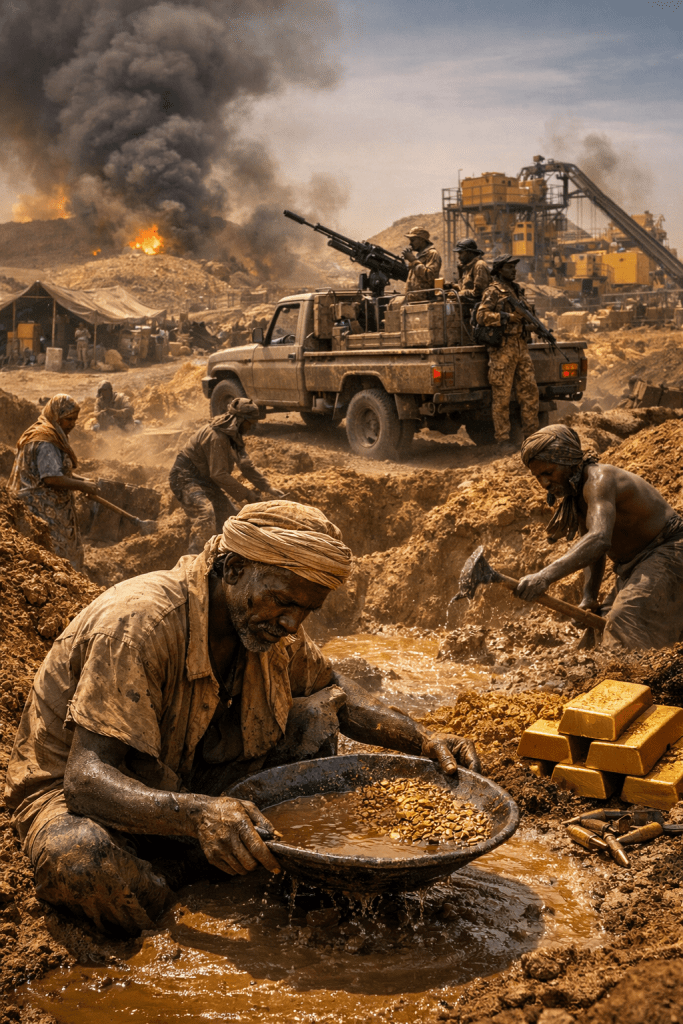
Gold mining in Sudan has grown rapidly over the last decade, turning the country into one of Africa’s top gold producers. But this boom did not translate into stability or shared wealth. Instead, gold became a currency of control. Armed groups, private militias, and shadow networks took hold of mining regions, using gold not as a national asset, but as fuel for prolonged conflict.
In remote areas, traditional miners dig by hand under extreme conditions, often risking their lives for a few grams of gold. Around them operate powerful actors with modern machinery, guarded routes, and international connections. The contrast is stark: survival at the bottom, influence at the top.
Gold revenues that could have funded schools, hospitals, and infrastructure instead slip through informal channels, crossing borders quietly. The metal moves faster than accountability. In a land where institutions are fragile, gold has become stronger than law.
Sudan’s gold is not just a mineral—it is a mirror. It reflects how natural resources, when captured by conflict and greed, can deepen instability instead of healing it. True wealth is not what lies underground, but what a nation chooses to build above it.
Until transparency replaces exploitation, Sudan’s gold will continue to shine for a few—while the country remains in the shadows.
 Histopedia
Leave a comment