The relationship between the United States and Israel often appears deeper than a normal alliance. Military aid, diplomatic protection, intelligence sharing, and unwavering political support make many people believe that the U.S. treats Israel almost like part of its own state. This perception is not accidental. It is the result of long-term strategic calculation rather than emotion.
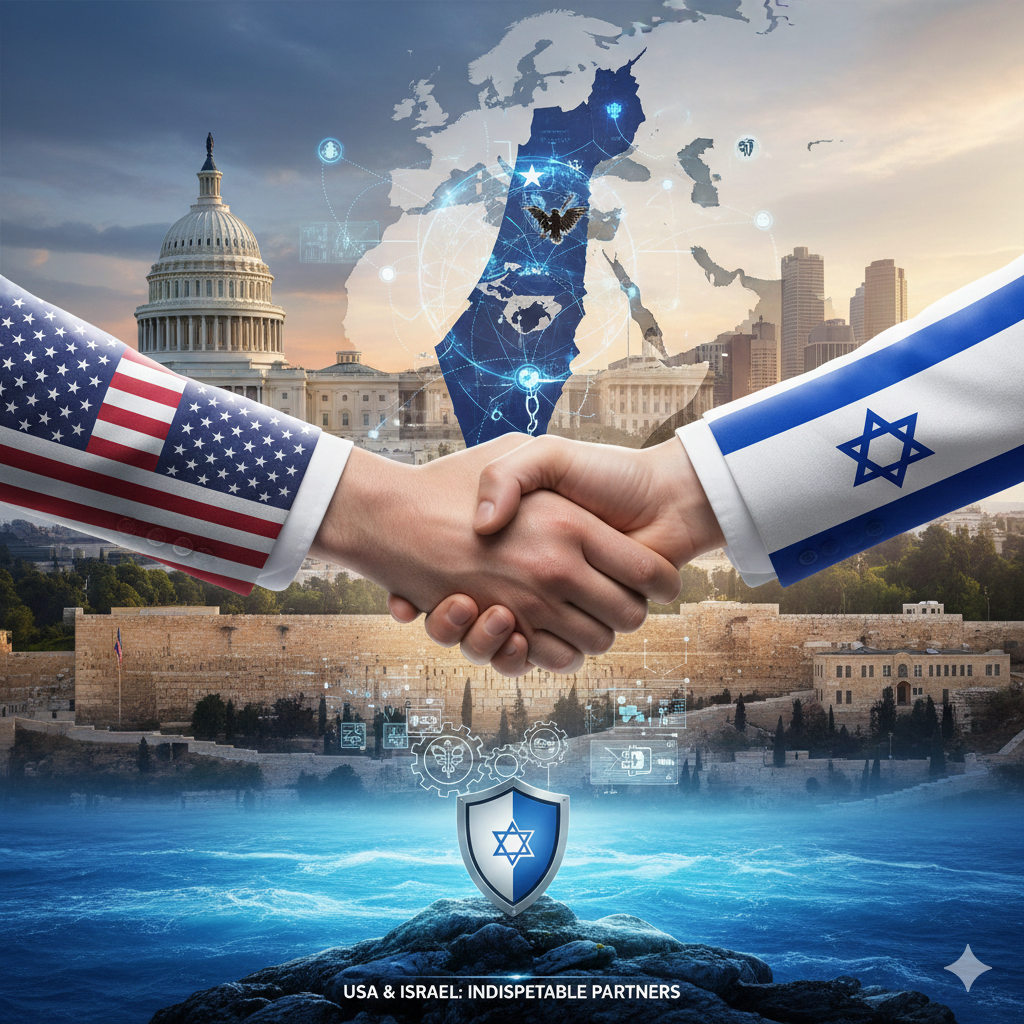
At the core, the Middle East is one of the most sensitive regions for global power. Energy routes, trade corridors, and security dynamics intersect here. Israel provides the United States with a stable and reliable partner in a region where political systems frequently change. While alliances elsewhere may shift, Israel remains consistent in supporting U.S. strategic interests.
Another key factor is alignment in political structure and worldview. Both countries project themselves as democracies with similar legal systems and governance values. This creates trust and ease of cooperation, especially in defense and intelligence. For the U.S., Israel is not just an ally, but a partner that understands and operates within the same strategic framework.
Security and intelligence cooperation further strengthens this bond. Israel’s intelligence capabilities offer the U.S. deep insights into regional threats, militant networks, and geopolitical movements. In modern geopolitics, information is power, and Israel acts as a critical source of that power for Washington.
Domestic politics inside the United States also play a significant role. Support for Israel is deeply rooted across political parties, influenced by lobbying groups, voter bases, and historical narratives. This internal consensus ensures continuity in U.S. policy toward Israel, regardless of leadership changes.
Economically and technologically, the relationship is mutually beneficial. Israel is a global leader in innovation, particularly in defense technology, cybersecurity, artificial intelligence, and medical research. U.S. investments and collaborations in these sectors generate long-term strategic and economic returns, making support for Israel a calculated investment rather than charity.
Most importantly, Israel allows the U.S. to project power in the Middle East without direct control or occupation. By supporting a strong regional ally, the U.S. maintains influence while reducing the costs and risks of direct involvement.
Legally, Israel is not part of the United States. But strategically, it functions as an extension of American influence, security interests, and geopolitical presence. In global politics, nations that consistently deliver results are treated not just as allies, but as indispensable partners.
 Histopedia
Leave a comment