In recent years, the corporate world has witnessed a curious pattern—many high-profile CEOs step down months before their companies face serious financial trouble or, in some cases, complete collapse. These exits are often framed as personal decisions or routine leadership transitions, but history suggests they are rarely coincidental.
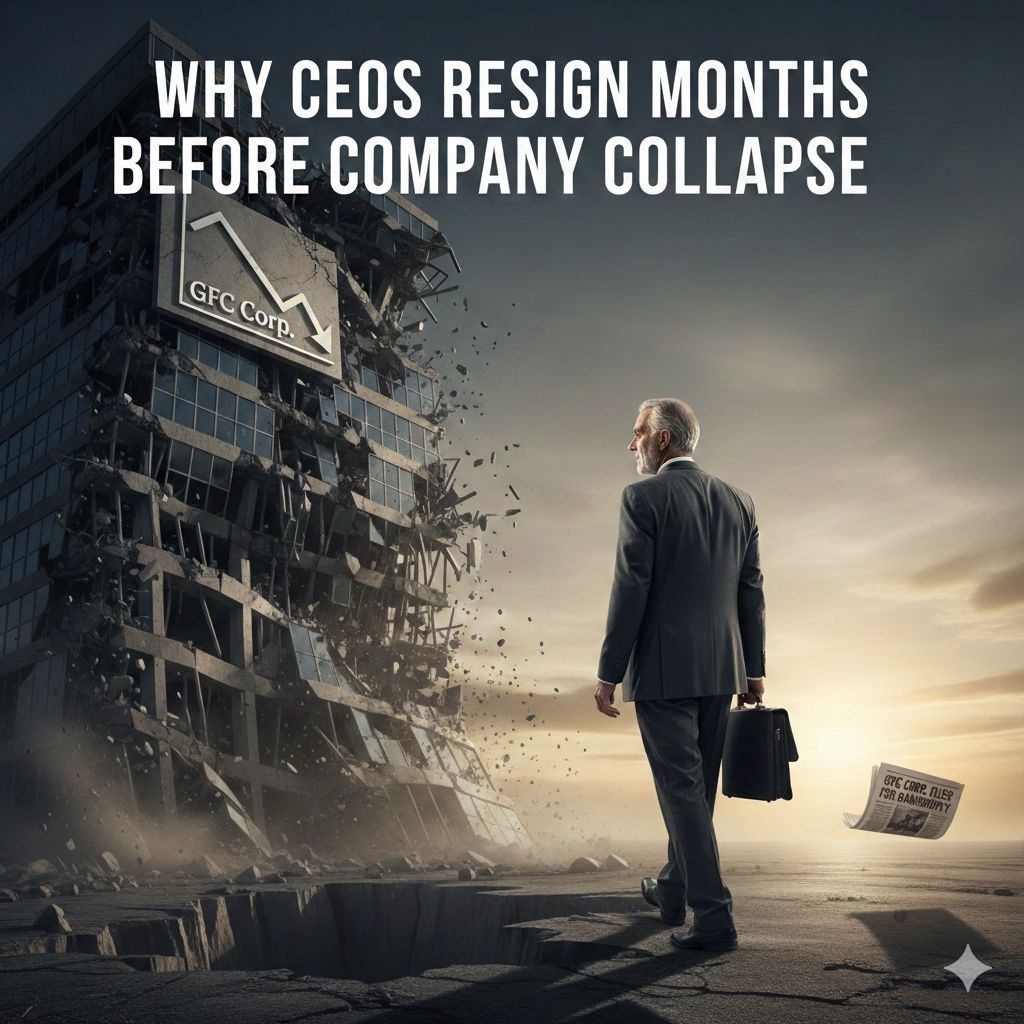
A CEO usually has access to internal data long before the public does. When financial performance begins to weaken, stock prices slip, or growth stalls, pressure quietly builds behind boardroom doors. Sometimes, the board loses confidence in the CEO’s ability to reverse the decline. In other cases, the CEO recognizes that the challenges ahead may be too deep or politically complex to overcome, making resignation the least damaging option.
Internal conflicts also play a major role. Disagreements with board members, major investors, or senior leadership teams can turn decision-making into a battlefield. When alignment disappears at the top, leadership change becomes inevitable. Scandals and reputational risks further accelerate exits, as companies attempt to contain damage by separating from leadership before issues escalate publicly. At times, a company may be entering a new strategic phase—restructuring, cost-cutting, or cultural change—and the existing CEO may simply not fit the future direction.
Several real-world examples reflect this pattern clearly. Heineken’s CEO Dolf van den Brink resigned in 2026 amid slow sales growth and rising investor dissatisfaction. Starbucks dismissed Laxman Narasimhan in 2024 after just 18 months, following underwhelming global performance and persistent controversies. Uber’s Travis Kalanick stepped down in 2017 after internal turmoil and repeated scandals threatened the company’s survival. In each case, the resignation was not the root cause of the problem but an early signal of deeper issues within the organization.
CEO departures often act as silent warnings for investors, employees, and customers. Leadership changes at the top create uncertainty and invite scrutiny, even when companies appear stable from the outside. As Ariane Marchis-Mouren of The Conference Board has noted, the rise in CEO departures—even among strong-performing firms—reflects a broader trend of higher executive turnover in today’s business environment.
A CEO resignation does not always mean a company is about to fail. However, when it happens suddenly, without clear explanation, or after a period of quiet underperformance, it is rarely meaningless. More often than not, it signals challenges that have already begun beneath the surface. In business, leadership exits tend to whisper the truth long before financial results make it impossible to ignore.
 Histopedia
Leave a comment